
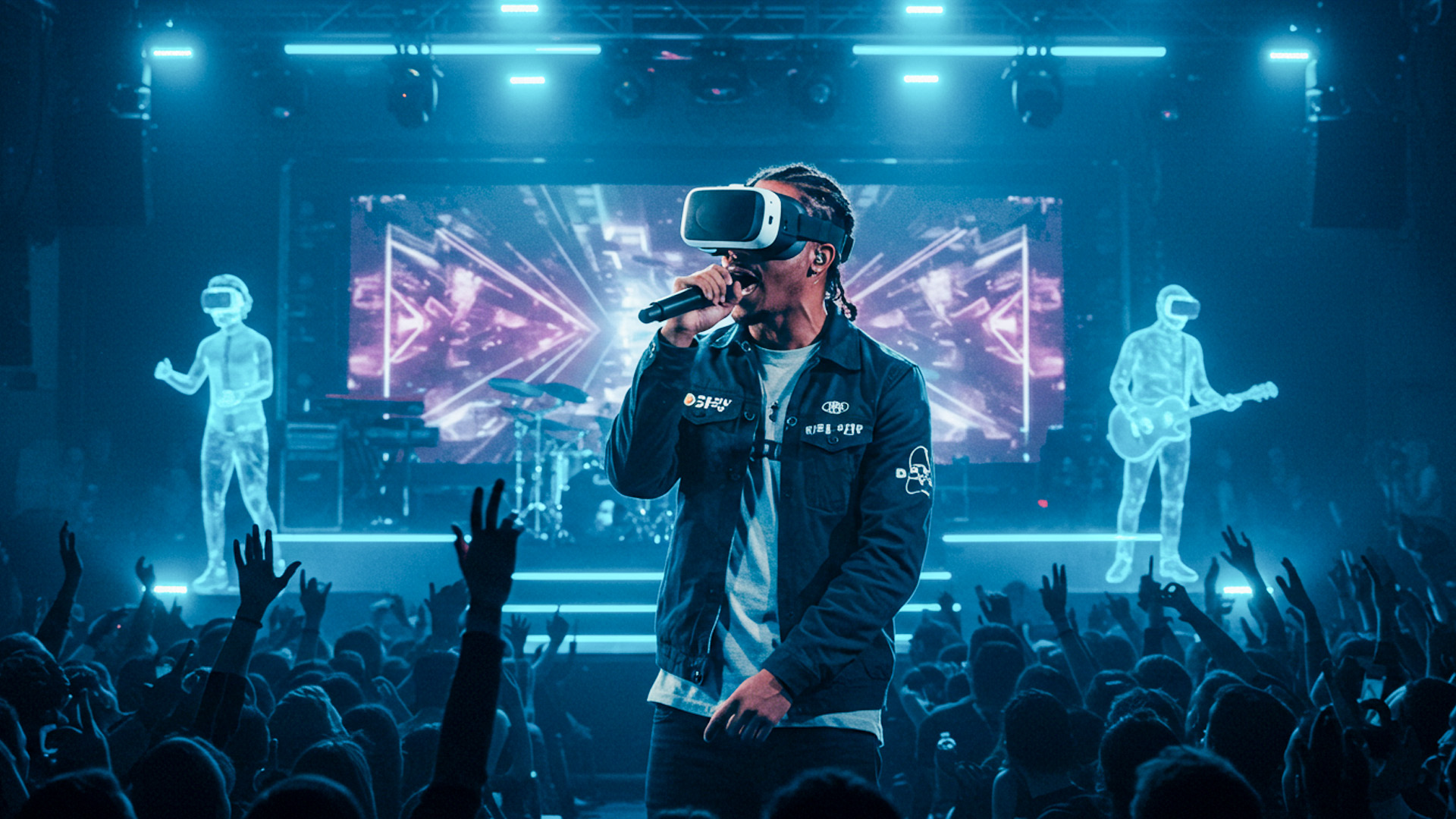
A Crossfade Between Headsets and Fields
Picture a desert dusk at Coachella: dust plumes, the bassline breathing, and a constellation of phones lifted like fireflies. Now crossfade to a living room where a headset hums to life, transporting its wearer into a Tomorrowland stage that blossoms and reconfigures like origami in zero-gravity. This article explores the tightrope between those worlds—how in-person mega-festivals and VR-native concerts are converging, diverging, and occasionally sampling each other. We’ll compare their social dynamics, technical scaffolding, accessibility promises, and environmental footprints. Consider it a backstage tour and a lab demo rolled into one, grounded in pragmatics yet willing to dream: two stages, one beat, and a future mixing desk with infinite channels.
Two Stages, One Beat: What Changes—and What Doesn’t
Rituals of Gathering vs. Protocols of Presence
Physical festivals are elaborate social rituals. You queue, you navigate merch lines, you search for your friends by an inflatable landmark that somehow everyone else chose too. These rituals create affordances for serendipity—overhearing a new artist at a small tent, sharing sunscreen with strangers, participating in the chaotic choreography of crowds. VR festivals swap serendipity’s geography for protocol: presence is negotiated through avatars, spatial audio zones, and moderation rules. The campfire glow becomes a server handshake; the wristband becomes a permissions token. Both are “presence engines.” One relies on shared air and body heat; the other, on latency budgets and identity layers that make presence persist across sessions.
In that sense, the core invariant is attention synchronized to sound. Whether you’re shoulder-to-shoulder under lasers or reclining on a couch, the performance still hitches emotions to tempo. Yet the inputs differ. A field is rich in analog micro-signals—sweat, wind, subwoofer pressure. VR transcodes these into haptics and psychoacoustic tricks, turning missing cues into designed illusions. When it works, it’s alchemy; when it breaks, you feel the uncanny seam. The pragmatic takeaway: neither mode fully subsumes the other. Instead, they form a continuum where the same “set” can be experienced through divergent channels, each adding or subtracting certain kinds of human texture.
Economies of Scarcity vs. Abundance
In-person festivals monetize scarcity: limited acreage, finite tickets, constrained sightlines. The economic architecture bundles music with place, time, and capacity. VR festivals monetize abundance: near-boundless “seating,” global reach by default, and repeatable, programmable stages. That shift reframes production risk. A physical promoter bets on weather, logistics, and municipal compliance. A VR organizer bets on concurrency, server autoscaling, and headset penetration. The cost curves differ, but so do upside profiles. A compelling VR show can be replicated across time zones, stitched with localized artist cameos, and sold as a software season pass rather than a single weekend wristband.
Crucially, abundance isn’t a synonym for value erosion. Digital stages can build premium tiers around interactivity: backstage Q&A instances, avatar meet-and-greets, synchronized haptic packs, and limited-edition cosmetic drops with provenance. Think of it as shifting from “I was there” to “I did this.” Physical festivals answer with experiential tiers—VIP decks, artist lounges, art cars. The long arc suggests hybrid models: buy a physical ticket, receive a persistent digital twin of your attendance with perks in a VR afterworld. That dual revenue stream strengthens resilience during disruptions and gives artists a programmable back catalog of performances that can be remixed post-show.
Safety, Moderation, and the Feel of Risk
Risk at physical festivals is concrete: heatstroke, dehydration, crowd crush, lost friends, logistical bottlenecks. Mitigation involves on-site medics, water stations, crowd flow modeling, and trained stewards. VR’s risk profile is subtler but real: social harassment through avatars, motion sickness, privacy leakage, and platform outages mid-set. Moderation becomes stagecraft. Organizers deploy proximity filters, report tools, instance sharding, and verified spaces to keep the vibe intact. The difference is between protecting bodies and safeguarding presence. You trade bruises for buffers, but the stakes remain human: trust that lets people surrender to sound without monitoring peripheral threats.
Interestingly, a calibrated dose of risk sometimes amplifies memory. The desert’s brutal sun or a midnight downpour can imprint a set into lore, the way vinyl crackle warms a track. VR can simulate adversity—a sudden shader storm, a stage that disassembles into instruments orbiting the crowd—but it is curated peril, obedient to code. That control is a feature for safety and accessibility; it’s also a design challenge for authenticity. Expect the best operators to blend gentle unpredictability with strong moderation, allowing near-misses and micro-adventures that feel organic while never compromising participant well-being.

Bandwidth, Bodies, and the Physics of Presence
Latency Budgets vs. Walking Distances
Presence has physics. At a field stage, your legs pay the tax: ten minutes from Main to Sahara, a kilometer to find water, a trek back to camp. In VR, your packets pay the tax: encoding, uplink, routing, rendering, reprojection. Designers juggle end-to-end latency budgets so that gestures and beats feel co-temporal. Spatial audio must anchor voices to avatars; otherwise, conversations smear into noise. Motion-to-photon targets, frame pacing, and network jitter become the new “walking distances.” When they’re low and stable, the world feels stitched; when they spike, the stage tears and presence leaks out like air from a tent.
This trade isn’t moral; it’s mechanical. You can spend human energy or compute energy to arrive at the chorus in time. Physical shows offer guaranteed fidelity of real acoustics and tactile bass but pay in fatigue and time. VR offers “instant teleport” but demands rendering discipline and QoS negotiation. A smart hybrid strategy uses VR rehearsals for stageflow testing—simulating foot traffic with agent-based models—then deploys the same environment as a companion world during the live weekend, giving remote fans synchronized presence while alleviating on-site congestion for those who made the pilgrimage.
Stagecraft as Software: From Lasers to Shaders
Lighting directors have long painted air with photons. VR elevates that craft into shader dramaturgy: geometry can bloom in impossible ways, gravity can invert on the downbeat, and the crowd can ride a procedural wave that crashes in perfect meter. The repertoire expands from pyrotechnics to parametrics. Artists collaborate with technical directors, VFX TDs, and real-time engine teams, treating the stage like a programmable instrument. Meanwhile, physical stages push robotics, kinetic scenography, drone swarms, and real-time visuals tied to biosensors. The design language converges: timelines, triggers, OSC messages, MIDI routing, and state machines driving moments of collective awe.
Software-defined stagecraft also shortens iteration cycles. A motif tested in a late-night VR pop-up can be promoted to the sunset slot at a major festival. Telemetry replaces hunches: heat maps of attention, dwell times near visual features, sentiment from emotes. There’s risk of over-instrumentation—chasing dashboards instead of goosebumps—but used judiciously, data becomes a rehearsal partner, not a tyrant. Physical venues can ingest these learnings, tuning pyro timings or pacing transitions. Conversely, VR can import tactile disciplines: blackouts used as palette cleansers, silence deployed like negative space, and narrative arcs that respect circadian rhythms even when time zones collide.
Embodiment, Haptics, and the Subwoofer Problem
Ask any festival veteran about “the drop,” and they might point at their sternum. Low frequencies are full-body experiences in physical spaces—subwoofers pressurize air, ribs resonate, sand vibrates. VR must cheat. Haptic vests, wristbands, and seat shakers map audio bands to tactors, translating bass into skinscapes. Done crudely, it’s a buzzing distraction; done artfully, it becomes synesthetic punctuation. Embodiment also spans locomotion. Room-scale is small; arenas are huge. Designers rely on directed teleportation, subtle vection cues, and world-in-motion tricks to satisfy the urge to wander without inducing nausea. It’s choreography with physics and perception on the call sheet.
This is where hybrid ingenuity shines. Imagine on-site “haptic pods” where remote VR attendees can proxy-ride physical sub arrays through networked transducers, or conversely, physical attendees renting lightweight wearable actuators paired to the same tactile tracks as the VR crowd. The objective isn’t to replicate one-to-one but to preserve the emotional topology: anticipation, impact, release. Think of it like mastering a track for different speakers. You don’t chase identical waveforms; you chase consistent intention across devices. When engineers and artists collaborate on the right mappings, the subwoofer problem becomes a palette, not a limitation.

Access Without Borders: Inclusivity and Accessibility
Geography, Cost, and the “First Ticket” Problem
The first ticket to a mega-festival is rarely the wristband; it’s airfare, visas, time off, and accommodation. For many fans, those invisible tickets are non-starters. VR detonates the distance constraint. A teenager in Lagos, a parent in Manila, or a shift worker in Porto Alegre can attend without negotiating borders or bank loans. Hardware still costs, but the total burden is usually lower and amortized across many shows. VR admits flexible session lengths—drop in for a 45-minute set, then return to obligations. Physical attendance is immersive by geography; VR is immersive by scheduling, which matters for the world’s actual lives.
Price discrimination can get smarter too. VR tiers can be tuned for local purchasing power, offering region-sensitive pricing without the logistics of shipping or scalper arbitrage. Gifting becomes native: a fan can sponsor access for another with a code, forming micro-patronage networks. Physical festivals can reciprocate by bundling VR access with general admission, ensuring friends who couldn’t travel still co-attend in a synchronized companion world. The result is a social topology that tolerates real-life constraints. Instead of FOMO, you get continuity: everyone catches the same headliner, some under desert stars, others under a ceiling fan, both inside the same dramaturgic arc.
Disability-Centered Design and Sensory Modulation
Traditional festivals have advanced with viewing platforms, captioned screens, quiet areas, mobility support, and trained accessibility teams. Yet real terrain, body density, and noise floors impose hard limits. VR can invert the defaults. Captions, sign-language overlays, and descriptive audio can be toggled on-demand. Sensory filters can lower visual intensity or compress dynamic range without shaming the user or isolating them. Locomotion alternatives respect mobility differences without requiring separate entrances or secluded spaces. In VR, the “front row” is a policy, not a staircase; the best sightlines are a transform, not a lottery. Accessibility becomes a first-class feature of stage design.
There’s nuance, of course. Headsets can burden necks, clash with assistive devices, and provoke cybersickness. Controllers may not suit all grips. Inclusive VR requires robust alternative inputs—head-gaze cursors, voice commands, eye-tracking selection—and thoughtful pauses that respect cognitive load. Community moderation also matters for psychological safety. The best practice is co-design: bring disabled creators and accessibility experts into line-level decision making, pay them, and treat their guidance as architecture, not patchwork. Physical venues should mirror that spirit: publish detailed wayfinding in advance, map acoustic refuges, and clearly document support services. Inclusion is an infrastructure, not a gesture.
Identity, Anonymity, and Social Comfort
Festivals are laboratories for identity play. Costumes, glitter, and camp names loosen the default self. VR scales that affordance with avatar-based expression that can decouple appearance from biology, age, or geography. For some, that’s liberatory; for others, the mask feels distancing. The key is consent and control. Pseudonymous presence can reduce social anxiety and harassment risk if paired with strong reporting and block tools. Verified spaces can provide “real-name” comfort where appropriate. The practical aim is a tunable social gradient—intimacy where desired, anonymity where needed—so people can calibrate their vulnerability without risking their safety or dignity.
Physical festivals already hint at this tunable gradient: you can vanish into a crowd at the main stage, then reconnect intensely at a small art installation. VR can make those gradients explicit through instance sizes, invite-only micro-stages, and social graphs that prioritize trusted proximity. Imagine “camp neighborhoods” ported into the headset, where your friend group has a persistent lounge adjacent to the headliner’s arena. That continuity reduces the friction of making friends and reduces the probability of unwanted encounters. The principle is simple: social chemistry is an engineering problem only in the sense that respect and agency must be designed in from day one.

Carbon Ledgers and Quiet Generators: Environmental Accounting
Transport Emissions vs. Compute Emissions
Most festival emissions come from moving people and gear: flights, buses, rideshare churn, and diesel generators. VR flips the ledger: far fewer transport miles, more compute cycles. A single server hour has a footprint, but it’s amortized across thousands of attendees and vastly smaller than aviation per capita. The right framing is marginal substitution. If each remote seat displaces a long-haul flight, the net wins are enormous even after counting data center energy. Meanwhile, the physical site can downsize generators, re-spec lighting, and reconfigure capacity. The metric evolves from “how big?” to “how efficient per joy unit?”—a humane KPI.
None of this absolves infrastructure. Data centers need clean power procurement, aggressive PUE targets, and workload shifting to renewable-rich hours. Compression pipelines and edge distribution can trim bitrate without crushing fidelity, further improving energy per spectator-minute. On the physical side, electrified stages, battery buffering, and smart grids shrink diesel dependence. Hybrid models help in both directions: remote attendance reduces travel emissions; on-site operations benefit from digital twins that optimize logistics. Sustainability ceases to be a constraint narrative and becomes a design brief: build delight that treads lightly, measure honestly, iterate relentlessly, and publish the playbook for others to copy.
Materials, Waste, and Circular Artifacts
Physical festivals embody themselves in stuff: scaffolds, banners, wristbands, single-use cups, art installations with limited reuse plans. VR swaps much of that for virtual assets, which carry upstream material costs only in the devices themselves. The practical goal is circularity. On-site, that means modular stages designed for reassembly, reusable serviceware, and merch lines that prioritize durable goods and repair. In VR, it means device longevity, refurb cycles, and interoperable digital fashion that isn’t marooned when a platform pivots. Artists can design installations with a second life: pieces that tour smaller venues, become civic infrastructure, or transform into community assets after the final encore.
The same ethos applies to data. Capture only what’s needed, store it minimally, and maximize its utility for operations and attendee benefit. Telemetry can help consolidate truck routes, right-size power, and schedule cleaning crews more efficiently. In VR, data helps tune codec ladders and stage asset streaming so we push fewer redundant bits. Waste is entropy; the job is to rechannel it as feedback. When the waste stream becomes a design input—whether aluminum, fabric, or megabytes—you establish a culture where sustainability isn’t a bolt-on but a talent magnet. People want to build for teams that treat the planet like a headline act.
Soundscapes, Night Skies, and Externalities You Can Hear
Beyond carbon, festivals impact soundscapes and skies: bass spill disturbing neighbors, light domes washing out stars, wildlife stressed by nocturnal activity. VR has almost zero local externalities; your neighbors might hear cheering through drywall, not a 30-kilowatt line array. Physical shows can mitigate with directional arrays, time-gated programming, and dark-sky-friendly lighting. There’s poetry in silence as a design asset. Imagine curfews that hand off to VR after-hours, where the party continues without violating noise ordinances. Locals sleep; global fans dance. The energy of the night is conserved, like switching a river into a gentle culvert instead of breaching its banks.
These externalities are also storytelling opportunities. On-site experiences can feature “quiet intermissions” where lighting dims to reveal constellations, paired with field guides and ambient sets. VR can replicate that with real-time sky data, teaching audiences to love the same constellations over Johannesburg and Tokyo. When festivals curate attention toward shared planetary context, the music inherits more gravity. You come for the drop; you leave remembering the quiet. That ethical arc is easier to maintain when both arenas—earth and cyberspace—respect their neighbors, whether that neighbor is a nesting bird or a family trying to sleep two kilometers away.
